I keep jam in the fridge.
Thinking about it, when it comes to jam, I’m actually using the fridge as a very expensive and inefficient storage cupboard – there is absolutely no need to keep it there. The whole point of making jam, of preserving, is storing fruit for a long time in a way that prevents it from going off. Fridges and freezers extend the shelf-life of fresh produce, but jam doesn’t belong there. Before refrigeration, jam was a way of enjoying apricots in December, strawberries in January and Blackcurrants in March. When the summer’s bounty would otherwise go to waste, boiling up the surplus with sugar and sealing it in sterilised jars was a way of making sure that not a single morsel was wasted. In 1785, Nicholas Appert worked out that boiling at high temperatures and sealing in air-tight containers would make fruit last a long time, and so Napolean’s armies marched on bellies full of jam (and they didn’t get scurvy).
Fridge-freezers are great. They allow us to keep our leftovers suspended between cooked and consumed for days, weeks, even months. If we are tired or sick or short on time we can pull something out and have it ready with minimal fuss or preparation. They mean we don’t have to shop for and prepare fresh food every day. Fridge-freezers helped to liberate the 1960s housewife to live the life she wanted away from the shackles of the stove.
Someone on my Facebook feed shared an anecdote about Kurt Vonnegut the other day. He told his wife he was going to the post office to buy a stamp. She suggested that he could go online and buy 100. He didn’t, because he only needed one, and he didn’t want to miss out on all the lovely encounters he’d have in the process of going to the post office to buy the stamp – spotting fire engines, chatting to a woman about her dog, seeing some cute babies. In our era of filling our fridge with an online shop, we’re potentially doing ourselves out of some of these moments that make the humdrum, boring hours of everyday existence fun and enjoyable. Food shopping is (and always has been) functional, but now it’s functional without any social benefits. You don’t even have to get out of doors in order to do it. Maybe in an indirect way, fridge-freezers have helped to contribute to the anatomisation of society.
In the 1940s, it was very rare to have a fridge. In fact, in 1948, just 2% of households in Britain had a fridge. By 1959 this figure had risen to just 13%. Even though many of us can’t perceive of a modern kitchen without a fridge (in fact, when I was still house-sharing a common question I’d ask at viewings was ‘how much fridge space will I get?’), it’s rather ironic that (given that the fridge is supposed to preserve food for longer) the modern household wastes far more food than in 1948. Of course in 1948 Britain was still under rationing, and the ‘waste not want not’ mentality is something that we have become very out of touch with in recent years.
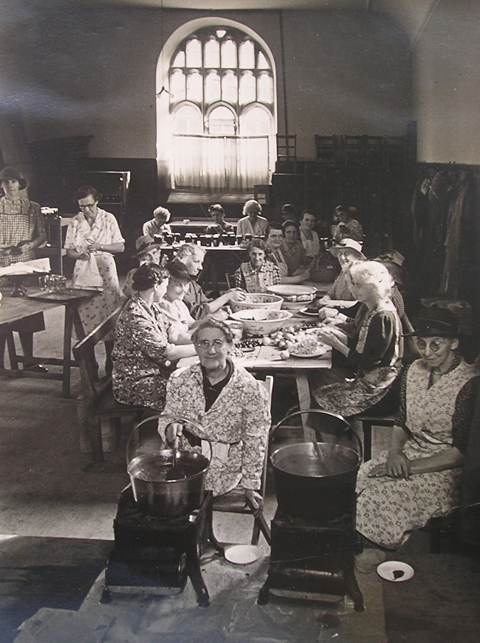
In 1939, the British government gave the Women’s Institute a grant of £1400 to buy sugar for preserving. I almost fell over backwards when I typed this into an inflation calculator and realised that in today’s money, that’s nearly £100,000 – just for the sugar. The overall money put into the scheme represented an investment of almost £400,000 in today’s money. All the women who grew, harvested, foraged and preserved this food were volunteers, and they kept none of it for themselves – it all went into the rationing system. Indeed, there were officers present to make sure that no one sneaked a jar or two home in their drawers! The preserving took place in designated ‘preservation centres’, of which there were more than 5000. These were mostly church halls and school kitchens. The fruit preserved from 1940-45 accounted for the entire jam ration of up to a million people. Thus, the classic image of the WI member was born – the jam-making stalwart of the village fair, the beacon of self-sufficiency, the no-nonsense grafter who rolled up her sleeves and offered her skills when her country was in crisis.
*waitaminit*
Women coming together in a crisis. Women rolling up their sleeves and saying ‘well what shall we do about this?’
We are in a crisis. Multiple crises. A global and economic and crisis. I’m not suggesting that making jam is the solution to climate change, social divisions and war (although I’d love it if it was) rather, I’m sure it’s one of the many. Creating moments of temporary community where we celebrate our surroundings, become intimate with the past and present of the world around us, find a commonality through a shared theme, make connections in a way we might not otherwise have an opportunity to, and produce something tangible to take home with us afterwards can, I believe, go some way to healing the great wounds we’ve inflicted on ourselves.
Maybe I’m too optimistic. And I have no idea how on earth I would measure this.
I’m half-tempted to throw out my fridge in a fit of idealism, though.
Sources:
https://www.thewi.org.uk/centenary/the-history-of-the-wi/jam-and-the-wi-during-the-second-world-war
 One for the Cupboard
One thought on “Food Before the Fridge”